Thursday, September 19, 2024

Quinone

 Quinones are a class of cyclic organic compounds characterized by their conjugated double-bond systems and a distinct chemical reactivity. The history of quinone can be traced back to the early 19th century, when chemists began to understand the structures and properties of these compounds.

Early Discoveries

  • 1826: The term "quinone" derives from "quinine," the alkaloid first isolated from the bark of the cinchona tree. The discovery of quinine itself in the 17th century by Jesuit missionaries in South America paved the way for subsequent studies into related compounds.

  • 1833: The first true quinone, 1,4-benzoquinone, was synthesized by the chemist August Wilhelm von Hofmann. He extracted it from coal tar, marking a significant step in organic chemistry.

Structural Elucidation

  • 1850s-1860s: Further advancements were made by chemists like Adolf von Baeyer and Hermann Emil Fischer, who studied the properties and reactions of quinones. Their work laid the foundation for understanding the electronic structure and reactivity of these compounds.

  • 1860: The structural formula of quinone was proposed, and it became evident that quinones could be derived from aromatic compounds through oxidation.

Expanding Knowledge

  • 20th Century: The chemical industry began to recognize the importance of quinones in various applications. They were found to be useful as dyes, pigments, and in pharmaceuticals. Quinones played a key role in the development of synthetic dyes and eventually in the field of biochemistry, where they were identified as intermediates in metabolic pathways.

Modern Applications

  • 1970s-Present: Quinones have gained attention in the fields of materials science and medicine. Their unique redox properties make them valuable in electronic applications, such as in organic solar cells and batteries.

  • Biochemistry: Quinones are now known to be important in biological systems, particularly in photosynthesis and cellular respiration, where they participate as electron carriers.

Conclusion

The study of quinones has evolved significantly from their initial discovery to their current applications in various scientific fields. Their unique chemical properties and biological significance continue to make them a topic of interest for researchers today.

Benzoquinone

 Benzoquinone is an organic compound with a rich history, pivotal in organic chemistry and various applications. Here’s an overview of its development:

Early Discoveries

Benzoquinone is derived from benzene, with its earliest forms identified in the mid-19th century. The compound is characterized by a six-membered aromatic ring with two ketone groups, existing mainly as 1,2-benzoquinone (ortho-quinone) and 1,4-benzoquinone (para-quinone).

19th Century

The isolation of benzoquinone compounds began in the 1830s. Researchers such as Charles Frédéric Gerhardt explored quinones' chemical properties, leading to increased interest in their structure and reactivity. The understanding of their roles in oxidation-reduction reactions was foundational in developing organic chemistry.

Chemical Structure and Types

Benzoquinone's structure, with its unique arrangement of double bonds and carbonyl groups, allows for a variety of reactions, including electrophilic substitutions and polymerizations. The identification of ortho- and para-quinones added depth to their chemical properties, influencing subsequent synthetic approaches.

20th Century Applications

In the 20th century, the synthesis of benzoquinone and its derivatives expanded significantly. Its utility in dyes, particularly in the textile industry, was notable. Benzoquinones became key intermediates in the production of various synthetic dyes due to their vibrant colors and stability.

Biological Significance

Benzoquinones also gained attention for their biological activities. They are involved in the biosynthesis of natural products and play roles in photosynthesis 

Naphthoquinone

Naphthoquinone is an organic compound that has a fascinating history tied to its discovery, synthesis, and applications.

Early Discoveries

Naphthoquinones are derivatives of naphthalene and are characterized by a fused ring structure containing two ketone groups. The discovery of naphthalene itself dates back to the early 19th century, when it was isolated from coal tar. The exploration of its derivatives led to the identification of naphthoquinones in the mid-1800s, with scientists investigating their chemical properties and potential uses.

Chemical Structure and Types

Naphthoquinones primarily exist in two forms: 1,2-naphthoquinone and 1,4-naphthoquinone. The distinction lies in the positioning of the carbonyl groups. 1,4-naphthoquinone, in particular, gained attention due to its role in biological systems, notably in the synthesis of vitamin K and its involvement in various biochemical pathways.

20th Century Developments

In the 20th century, advancements in organic chemistry allowed for the synthesis of naphthoquinones, which spurred interest in their applications. Researchers began exploring their use in dyes, pharmaceuticals, and as intermediates in chemical reactions. The compound's unique properties, including its redox activity, also made it a candidate for applications in electrochemistry and materials science.

Biological Significance

Naphthoquinones have been recognized for their biological significance. For instance, 1,4-naphthoquinone is essential in the biosynthesis of vitamin K, a vital nutrient for blood coagulation. Moreover, certain naphthoquinones, like menadione (vitamin K3), have been studied for their potential anticancer properties and as antibacterial agents.

Contemporary Research

Today, naphthoquinones are subjects of ongoing research in various fields, including medicinal chemistry and environmental science. Their roles in natural products and as precursors in the synthesis of complex molecules are of particular interest. Researchers are also investigating their potential in nanotechnology and as dyes in solar cells.

Conclusion

The history of naphthoquinone reflects a journey from early chemical exploration to modern applications in health and technology. As research continues, the potential of these compounds may lead to new discoveries and innovations in various scientific disciplines.

Saturday, November 14, 2020

Synthesis, photophysical and anticancer study of D-ring extended estrone analogues

 RSC Advances 2015, 5, 68843-68851

Hardesh K. Mauryaa, Mohammad Hasanainb, Ch. Pavan Kumarc, Prema G. Vasudevad, Jayanta Sarkarb, M. Chandrasekharamc and Atul Gupta*a

A concise route for the highly substituted ring extended estrone derivatives has been established. This protocol involves very simple, facile and one step ring transformation and cyclization process. The preliminary absorption, emission spectroscopic and biological studies of these compounds revealed the possible use of such prototypes in cancer chemotherapy as fluorescence probes.

Wednesday, October 28, 2015

Crystal structures of four [delta]-keto esters and a Cambridge Structural Database analysis of cyano-halogen interactions

K. Kamal, H. K. Maurya, A. Gupta and P. G. Vasudev

RESEARCH PAPERS
Acta Cryst. (2015). C71, 921-928
doi:10.1107/S2053229615017106

The revived interest in halogen bonding as a tool in pharmaceutical cocrystals and drug design has indicated that cyano-halogen interactions could play an important role. The crystal structures of four closely related [delta]-keto esters, which differ only in the substitution at a single C atom (by H, OMe, Cl and Br), are compared, namely ethyl 2-cyano-5-oxo-5-phenyl-3-(piperidin-1-yl)pent-2-en­oate, C19H22N2O3, (1), ethyl 2-cyano-5-(4-methoxyphenyl)-5-oxo-3-(piperi­din-1-yl)pent-2-enoate, C20H24N2O4, (2), ethyl 5-(4-chlorophenyl)-2-cyano-5-oxo-3-(piperidin-1-yl)pent-2-enoate, C19H21ClN2O3, (3), and the previously published ethyl 5-(4-bromo­phenyl)-2-cyano-5-oxo-3-(piperidin-1-yl)pent-2-enoate, C19H21BrN2O3, (4) [Maurya, Vasudev & Gupta (2013). RSC Adv. 3, 12955-12962]. The molecular conformations are very similar, while there are differences in the molecular assemblies. Intermolecular C-H...O hydrogen bonds are found to be the primary interactions in the crystal packing and are present in all four structures. The halogenated derivatives have additional aromatic-aromatic interactions and cyano-halogen interactions, further stabilizing the molecular packing. A database analysis of cyano-halogen interactions using the Cambridge Structural Database [CSD; Groom & Allen (2014). Angew. Chem. Int. Ed. 53, 662-671] revealed that about 13% of the organic molecular crystals containing both cyano and halogen groups have cyano-halogen interactions in their packing. Three geometric parameters for the C-X...N[triple bond]C interaction (X = F, Cl, Br or I), viz. the N...Xdistance and the C-X...N and C-N...X angles, were analysed. The results indicate that all the short cyano-halogen contacts in the CSD can be classified as halogen bonds, which are directional noncovalent interactions.

Monday, March 16, 2015

Natural and Synthetic Molecular Medicine in Cancer Research: A Review

Review Article
Hardesh K Maurya*
Medicinal Chemistry Department, CSIR-Central Institute of Aromatic and Medicinal Plants, Picnic Spot road,
Lucknow-226015, India
Abstract
This review presents the stimulating area of natural and synthetic anticancer drugs which are presently used for the cure of various type of cancer. In this review, twenty one naturally, semisynthetic naturally occurring and 109 synthetic anticancer drugs are reported. The emphasis of this review has described related structure, mechanism of action and major disadvantage of these drugs with the aims of providing an overview of anticancer drugs. This review will be provide current status of cancer drug and helpful to make strategy in the
search of novel anticancer molecular medicine in future.
Keywords: Anticancer drugs; Chemotherapy; Cancer; Carcinoma; Tumor; Cancer medicine

Tuesday, September 30, 2014

Micelles catalyzed one pot regio- and chemoselective synthesis of benzo[a]phenazines and naphtho[2,3-d]imidazoles “in H2O”

      • Tetrahedron Letters, In Press, Accepted Manuscript, Available online 28 September 2014
  • Vishnu K. Tandon, 
  • Manoj K. Verma, 
  • Hardesh K. Maurya, 
  • Sandeep Kumar

Tuesday, May 13, 2014

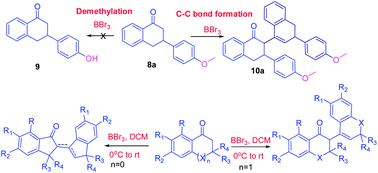
Boron tribromide mediated C-C bond formation in cyclic ketones: a transition metal free approach

Imran Ahmad, Vinay Pathak, Prema G Vasudev, Hardesh K. Maurya and Atul Gupta  


RSC Adv. 2014, 4, 24619 

DOI: 10.1039/C4RA01745E
                      

Received 27 Feb 2014, 
Accepted 12 May 2014
First published online 13 May 2014


Abstract
Borontribromide (BBr3) is a well known demethylating agent. Current investigation was focused on a new application of borontribromide as C-C bond forming agent in cyclic ketones. In this study, borontribromide mediated C-C bond formation reactions of tetralones, chromenone, thiochromenone and indanones were explored. Methoxy group containing ketones showed selective C-C bond formation reaction instead of demethylation of methoxy group. MM2 steric energy calculations for final products showed that reaction favored the formation of exo or endo cyclic double bond containing products depending upon their low MM2 steric energy in a specific frame structure as observed in x-ray crystallography. A comprehensive crystallographic and pi-stacking analysis of product 10a exhibited the formation of 10a as enantiomeric mixture and its centre of inversion was stabilized by a set of three unique pi-pi interactions.
Graphical abstract: Borontribromide-mediated C–C bond formation in cyclic ketones: a transition metal free approach

Wednesday, May 7, 2014

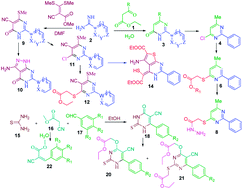
A convenient synthesis of pyrimidinone and pyrimidine containing bisheteroarenes and analogs

Hardesh K. Maurya and   Atul Gupta  
RSC Adv., 2014, 4, 22106-22114

DOI: 10.1039/C4RA01689K
                      

Received 26 Feb 2014, 
Accepted 02 May 2014
First published online 07 May 2014


Abstract
The synthesis of pyrimidinone containing bisheteroarenes (3) and related analogs (9 and 10) by the reaction of active methylenes or substituted methyl acrylate with nitrogen containing precursors viz amidines, or thiourea in water as well as other organic solvents was studied. Synthesized compounds had further been explored for the synthesis of diversified pyrimidines 4, 6-8, 11-12 and 14 through sequential approach.
Graphical abstract: A convenient synthesis of pyrimidinone and pyrimidine containing bisheteroarenes and analogs

Monday, May 5, 2014

Regioselective synthesis of polycyclic aza-oxa and aza-oxa-thia heteroarenes as Colo-205 and HepG2 carcinoma cells growth inhibitors

European Journal of Medicinal Chemistry,Volume 81, 23 June 2014, Pages 367–377 Available online 5 May 2014
Hardesh K. Maurya, Sanjay K. Gautam, Ramendra Pratap, Vishnu K. Tandon, Abhinav Kumar, Brijesh Kumar, Shruti Saxena, Deepti Tripathi, Meenakshi Rajwanshi, Mukul Das, Vishnu Ji Ram

DOI: http://dx.doi.org/10.1016/j.ejmech.2014.05.013

Abstract

An efficient regioselective synthesis of polycyclic diheteroaryl[b,d]pyrans and diheteroaryl[c,e][1,2]diazepines has been reported through ring transformation reactions of 2-oxo-2,5-dihydrothiochromeno[4,3-b]pyrans (3,4), 2-oxo-5,6-dihydro-2H-benzo[b]pyrano[2,3-d]oxepine/thiepine (8, 9) and 6-oxo-3,6-dihydro-2H-naphtho[1,2-b]pyrano[2,3-d]oxepine (15) by hydrazine, at ambient and reflux temperature. Nine compounds viz 5a,b; 10a,c,d; 12b; 13b; 16 and 1-methylthio-5,6-dihydrobenzo[f]quinoline (0.1-100 μM) were screened for their cytotoxicity in normal (IEC-6), carcinoma (Colo-205) and Hep G2 cell lines. None of the compounds showed cytotoxicity in normal IEC-6 cells while 10a,d and 16 resulted in killing of Colo-205 cells with IC50 ranging between 20-60μM while 10c and 13b caused killing of HepG2 cells with IC50 values ranging between 60-80 μM concentration. Further, 10a,d and 16 caused apoptosis through a cascade of mitochondrial pathway in Colo-205 cells indicating anticancerous potential against intestinal cancer. Interestingly, compounds 10c and 13b exhibited apoptosis through mitochondrial pathway in HepG2 cells suggesting anticancer activity against hepatic cancer.
image

Synthesis and biological evaluation of substituted 4,6-diarylpyrimidines and 3,5-diphenyl-4,5-dihydro-1H-pyrazoles as anti-tubercular agents

Bioorganic & Medicinal Chemistry Letters, Volume 24, Issue 13, 1 July 2014, Pages 2892–2896, Available online 4 May 2014
Vinay Pathak, Hardesh K. Maurya, Sandeep Sharma, Kishore K  Srivastava, Atul Gupta

DOI: http://dx.doi.org/10.1016/j.bmcl.2014.04.094

Abstract

Various substituted 4,6-diarylpyrimidin-2-amine (4), 4,6-diaryl-2-(heteroaryl)pyrimidine (6) and 1-(3,5-diaryl-4,5-dihydro-1H-pyrazol-1-yl)ethanone (7) derivatives were synthesized in good yields using simple methodology. The synthesized compounds (4-7) were evaluated for their in vitro anti-tubercular activity against Mycobacterium tuberculosis H37Rv strain. Compounds 4a, 6b, 7b, and 7c exhibited significant anti-tubercular activity at MIC values 25, 25, 12.5 and 12.5 μM concentration. In vitro cytotoxicity data using non cancerous hepatic monocytes (THP-1) cells indicated that most active compounds 7b and 7c were safe as their MIC values were much lower than their cytotoxic values
image

Thursday, February 20, 2014

Synthesis and evaluation of 2-heteroaryl and 2,3-diheteroaryl-1,4-naphthoquinones that potently induce apoptosis in cancer cells

Vishnu K. Tandon,   Hardesh K. Maurya,   Sandeep Kumar,  Aijaz Rashid and   Dulal Panda  
Full TextDOI: 10.1039/C3RA47720G
This article describes the preparation of 2-heteroaryl and 2,3-diheteroaryl-1,4-naphthoquinones by an environmentally benign short synthetic route with the goal of finding 1,4-naphthoquinone derivatives that induce apoptosis in cancer cells. We have identified three most active naphthoquinones 10, 12 and 15 that potently induce apoptosis in human cervical carcinoma (HeLa) cells. One of these three compounds perturbed both microtubule and actin filaments.

Monday, February 3, 2014

A carbanion induced synthesis of highly congested pyrazole and imidazole containing heterocycles

Tetrahedron Letters, Volume 55, Issue 10, 5 March 2014, Pages 1715-1719
Hardesh K Maurya, Atul Gupta
Medicinal Chemistry Department, Central Institute of Medicinal and Aromatic Plants, P.O. CIMAP, Kukrail Road, Lucknow-226015, India
http://dx.doi.org/10.1016/j.tetlet.2014.01.095

Abstract

An efficient approach to the synthesis of highly congested di, penta and hexacyclic pyrazoles as well as imidazole fragment containing novel heterocyclic molecule has been developed through a carbanion induced transformation of suitably functionalized 2H-pyran-2-ones, benzo[h]chromene and thiochromeno[4,3-b]pyrans. Due to the presence of fluorescence, we report their prime application metal sensor as off/on switching in ferric ions.

Saturday, September 7, 2013

Studies on substituted benzo[h]quinazolines, benzo[g]indazoles, pyrazoles, 2,6-diarylpyridines as anti-tubercular agents

Bioorganic & Medicinal Chemistry Letters,  Volume 23, Issue 21, 1 November 2013, Pages 5844–5849, Available online 5 September 2013
Hardesh K. Maurya, Ruby Verma, Saba Alam, Shweta Pandey, Vinay Pathak, Sandeep Sharma, Kishore K. Srivastava, Arvind S. Negi, Atul Gupta
http://dx.doi.org/10.1016/j.bmcl.2013.08.101
Abstract
Various substituted 5,6-dihydro-8-methoxybenzo[h]quinazolin-2-amine, 1-(3-(4-alkoxyphenyl)-7-methoxy-3,3a,4,5-tetrahydro-2H benzo[g]indazol-2-yl)ethanone, pyrazole and 2,6-diarylpyridine derivatives have been synthesized in good yields by an efficient methodology. The synthesized compounds (4-23) were evaluated for their in vitro anti-tubercular activity against Mycobacterium tuberculosis H37Rv strain. Compounds 6a,6c, 8a, 19a and 19e exhibited significant anti-tubercular activity at MIC values 50, 100, 50, 25 and 100 μM concentration. In vitro cytotoxicity data using THP-1 cells indicated that most active compound 19a is safe as its MIC value is much lower than the cytotoxic value.

Saturday, May 18, 2013

A Regio Selective Synthesis of 2,6-Diarylpyridines

Hardesh K. Maurya,   Prema G Vasudev and   Atul Gupta

 RSC Adv., 2013,3, 12955-12962 

DOI:  http://dx.doi.org/10.1039/C3RA41575A
A regio selective synthesis of 2,6-diarylpyridines through base (sodium hydroxide in DMSO) catalyzed ring transformation of suitably functionalized 2H-pyran-2-ones with benzamide has been delineated. However, similar reaction of 2H-pyran-2-ones with benzamide using base sodium hydroxide in absolute ethanol have yielded highly congested delta keto esters with active methylene centre instead of 2,6-diarylpyridines.


Saturday, August 25, 2012

A carbanion induced ring switching synthesis of spiranes an unprecedented approach


Hardesh K. Maurya ,  Ramendra Pratap ,  Abhinav Kumar ,  Brijesh Kumar ,  Volker Huch ,  Vishnu K. Tandon and Vishnu Ji Ram

                                                                                                                                           
          View Full text (RG),

DOI: 10.1039/C2RA21587J

An unique approach to the synthesis of heterocyclic spiranes through ring switching transformation of suitably functionalized 2H-pyran-2-ones, benzo[h]chromene and thiochromeno[4,3-b]pyrans has been developed. The spirane dimer 11d displayed interestinghalogen-hydrogen bonding to generate an elliptical cavity and may be relevant to the generation of a host guest assembly for specific cations and also a low helimerization energy barrier of spirane 17a.

Saturday, May 26, 2012

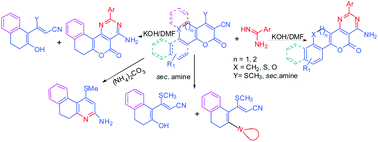
A Diversified Approach to the Synthesis of Highly Functionalized Novel Azines and Azoles from 2H-Pyran-2-ones

Heterocycles 2012,     DOI: 10.3987/COM-12-S(N)1

Pushyamitra Mishra, Sandeep Kumar, Hardesh K. Maurya, Sanjay K. Gautam, Brijesh Kumar, Vishnu K. Tandon,* and Vishnu Ji Ram*
Abstract
One-pot regioselective synthesis of 2,6-diarylpyrimidines (4), 2,6-disubstituted pyridines (5 and 6), 5-aryl-3-cyanomethyl-1H-pyrazoles (7) through base catalyzed ring transformation of suitably functionalized 2H-pyran-2-ones by arylamidines, cyanamide, ammonium carbonate, hydrazines respectively has been developed. Our synthetic approach opened a new avenue for the regioselective synthesis of 2,6-diarylpyrimidines and 2,6-disubstituted pyridines and cyanomethylpyrazoles. The procedure is very simple, efficient and economically viable. The protocol provides an efficient methodology for the preparation of new class of medicinally useful and highly functionalized azines and azoles from single precursor 2H-pyran-2-ones.

Sunday, March 25, 2012

Sequential approach to the synthesis of ‘U and Z’ shaped polycyclic heteroarenes

Organic & Biomolecular Chemistry


Hardesh K. Maurya ,  Sanjay K Gautam ,  Ramendra Pratap , Vishnu K. Tandon ,  Abhinav Kumar ,  Vikas Bajpai ,  Brijesh Kumar and Vishnu Ji Ram

Org. Biomol. Chem., 2012, 10, 4977              
DOI: 10.1039/C2OB25173FThe synthesis of three new classes of heteroarenes, built through the sequential fusion of naphthalene, benzo/naphtho[b]oxepine and thiochromene rings with pyran and pyrimidine ring system to give ‘U and Z’ shapes of structural frame work is reported. The methodology is based on the synthesis of pyran fused intermediates, 1-methylthio-3-oxo-5,6-dihydro-3H-benzo[f]chromene-2-carbonitrile (3), 4-methylthio-2-oxo-5,6-dihydro-2H-benzo/naphtho[b]pyrano[2,3-d]oxepine-3-carbonitriles (10, 20) and 4-methylthio-2-oxo-2,5-dihydrothiochromeno[4,3-b]pyran-3-carbonitriles (15) from the reaction of 2-tetralone, benzo/ naphtho[b]oxepin-5-ones and thiochromen-4-ones with methyl 2-cyano-3,3-dimethylthioacrylate respectively. Further condensation of intermediates 3, 10, 20 and 15 with amidines led to the formation of tetracyclic ‘U’ shaped 4-amino-2-aryl-7,8-dihydro-5-oxo-5H-naphtho[2,1-b]pyrimido[4,5-d]pyrans (8) and ‘Z’ shaped 4-amino-2-aryl-5-oxo-12,13-dihydro-5H-benzo/naphtho[b]oxepino[5,4-b]pyrimido[4,5-d]pyrans (12, 22) and 4-amino-2-aryl-5-oxo-5,12-dihydrothiochromeno[4,3-b]pyrimido[4,5-d]pyrans (17). Compound 12f forms chain of dimers through N-H∙∙∙O interactions as indicated by the X-ray structure analysis and the quantum chemical calculations performed at the MP2 level indicates that this interaction energy is 10 kJ mol.-1 
Graphical abstract: Sequential approach to the synthesis of ‘U and Z’ shaped polycyclic heteroarenes